Granada Day Tours
I’m Serious Day Tour Man AI, your day trip expert. Ask me anything — where to go, how to get there, and what’s actually worth your day.
Granada’s day trips climb and descend like nowhere else in Spain: mainland Europe’s southernmost ski resort operates forty minutes from a city where oranges line the streets, white villages hang in a gorge the Moors terraced a millennium ago, and the coast — subtropical enough to grow mangoes — sits an hour down the mountain.
The city block carries the page’s most important mechanics: the Alhambra ticket system, which is strict, online-only, sold out months ahead in season, and surrounded by lookalike websites — the details below are current and worth reading before anything else gets booked.
Here’s what’s worth a day, with real times and honest trade-offs.

Popular Day Trips
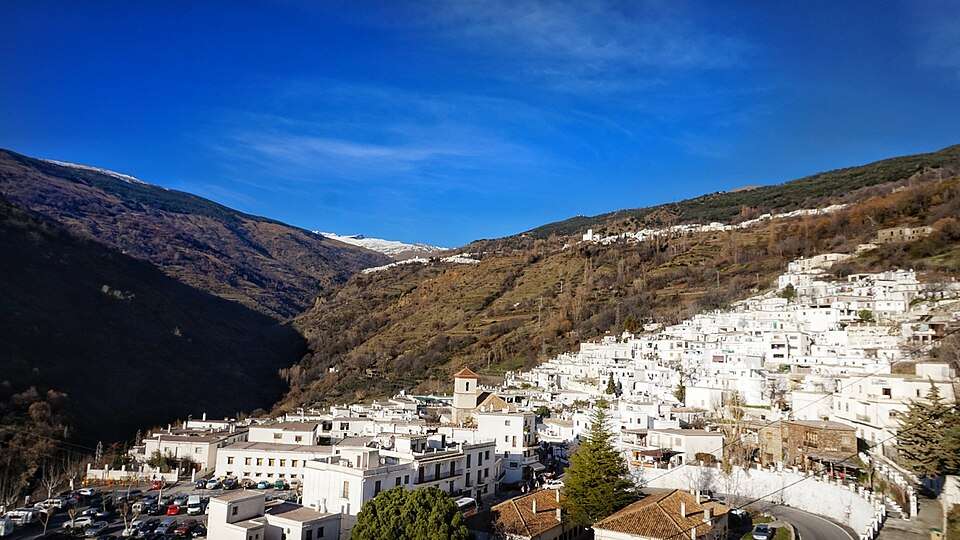
Alpujarras
White Villages, the Poqueira Gorge
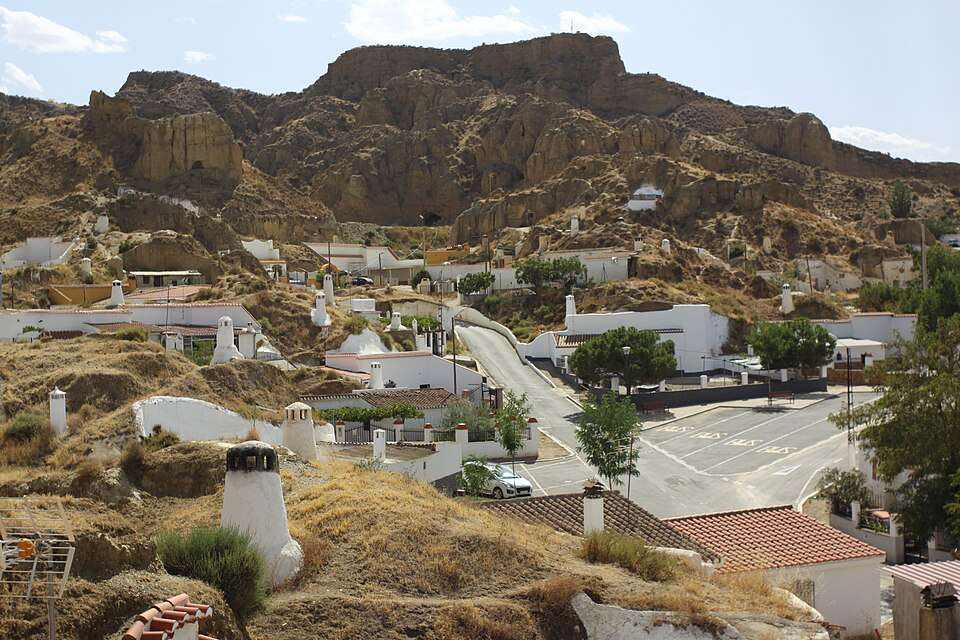
Guadix
Two Thousand Cave Houses, Chimneys in the Badlands
The Alpujarras — The Hanging White Villages
An hour southeast, the Alpujarras fold into the Sierra Nevada’s southern flank: the last refuge of the Moors after Granada fell, terraced and irrigated by them so thoroughly that the villages still drink from their acequias. The classic circuit climbs the Poqueira gorge’s stacked trio — Pampaneira, Bubión, and Capileira — whitewashed, flat-roofed, and Berber in bone structure, each higher and quieter than the last.
The day: walk between the three on the gorge paths (Pampaneira to Capileira runs a couple of honest uphill hours, with the bus back solving the return), buy the jarapa rugs and honey at the source, and eat the plato alpujarreño — the mountain fry-up of ham, sausage, egg, and peppers that assumes you walked first. Trevélez, further in, cures Spain’s most famous jamón at 1,500 meters and sells it accordingly.
The road is all curves (medicate the motion-prone), winter snow reaches the upper villages, and spring — when the snowmelt runs loud through the channels and the almond blossom comes — is the glory window. This is the region’s soul-food day, and the right first trip out of the city.
Read the full Alpujarras day-trip page.
Sierra Nevada — Snow at Africa’s Latitude
Forty minutes up Europe’s highest road-served range, the Sierra Nevada runs two seasons of day trip. Winter (roughly late November through April, one of Europe’s longest seasons thanks to altitude): mainland Spain’s premier ski resort at Pradollano, with slopes to 3,300 meters, rental everything on-mountain, and the novelty that sells the trip — morning skiing with the Mediterranean visible from the lifts, and the genuinely possible ski-morning-beach-afternoon double in spring.
Summer inverts it: the resort’s lifts serve bike parks and hikers, and the high road toward the Veleta — Europe’s second-highest paved-road access — opens walking country above 3,000 meters where the views run to Morocco on clear days. Mulhacén, mainland Spain’s highest peak at 3,479 meters, is a full guided or experienced-walker undertaking from the Alpujarras side, not a casual add-on.
Three rules apply: altitude is real (hydrate, pace, sunscreen at double strength — the UV at 3,000 meters over snow is industrial), weekend winter traffic queues at the access road, and chains ride in the trunk in season. Skiers and hikers get a world-class half day at commuter distance; everyone else gets the viewpoint drive and lunch at Pradollano, which is enough.
Nerja & Frigiliana — The Caves and the Coast
An hour south, the Costa Tropical pairing runs underground and uphill. The Nerja Caves are the coast’s great cavity: cathedral-scale chambers holding the world’s largest recorded stalagmite-column formations, walked on a stepped circuit past halls that host summer concerts — book tickets ahead on the caves’ official site in season, wear real shoes, and expect the temperature drop.
Nerja town supplies the seaside hour: the Balcón de Europa’s palm-lined promontory over the water, the beach coves below (Calahonda for the postcard), and espetos — sardines grilled on cane skewers over boat-hulled fires — as the mandatory lunch.
Frigiliana, ten minutes up the hill, is the white-village showpiece: cobbled lanes, blue-pot-against-whitewash photography at saturation, and a Moorish quarter that regularly tops Spain’s prettiest-village polls — earned, and correspondingly busy by noon, so take it before the coaches or at golden hour. This is the gentlest full day on the list — caves, lunch, village, swim in the warm months — and the family default for good reason.
Guadix & the Geopark — The Underground District
Forty-five minutes northeast, Guadix answers a question most visitors never thought to ask: what if a cathedral town’s suburbs were underground? The Barriada de las Cuevas is Europe’s largest inhabited cave district — thousands of homes dug into the soft badlands, whitewashed chimneys poking from the hillsides, cool at 20 degrees year-round while the plain outside bakes. The cave museum and the mirador over the chimney-studded barrio tell it properly, and several cave homes open for visits; take one — the interiors surprise everyone.
The town above ground fills its hour well: the sandstone cathedral, the Alcazaba’s Moorish walls, and a plaza economy blessedly unbothered by coach tourism. The landscape around it is the Granada Geopark: badlands, gullies, and desert-film scenery, with the Gorafe dolmen field — hundreds of prehistoric tombs scattered across a canyon — as the deep-history add-on for drivers.
This is the connoisseur’s half day — cheap, strange, and utterly unlike the postcard Andalucía — and it pairs with the Renaissance castle at La Calahorra or the drive back through the badlands at low sun. Second-visit material for most; first-pick for the curious.
Read the full Guadix day-trip page.
Córdoba — The Honest Stretch
Two hours west by car or bus (the direct trains run slower than the road here), Córdoba is the region’s stretch day, and the Mezquita justifies it: the mosque-cathedral whose thousand candy-striped arches hold a Renaissance cathedral grown improbably through their middle — the single most argued-about building in Spain and among the most extraordinary interiors in Europe. Book ahead online, go at opening before the tour groups compress the forest of columns, and give it the unhurried ninety minutes it demands.
The rest of the circuit: the Judería’s whitewashed lanes and the Calleja de las Flores, the Roman bridge and Calahorra tower over the Guadalquivir, the Alcázar’s gardens, and — in May — the Patios festival, when private courtyards open their flower-drenched interiors and the city briefly becomes the most beautiful in Spain (book that fortnight far ahead).
The math: four-plus hours of round-trip travel around four or five on the ground works, with an early start. Summer makes its own argument — Córdoba is routinely Spain’s hottest city, and July–August middays run brutal; the season math says spring and fall, or a dawn start and a siesta-structured day. Seville, note plainly, is not a day trip from Granada worth taking — it needs its own base.
The Alhambra Rules, the Albaicín & Granada Itself
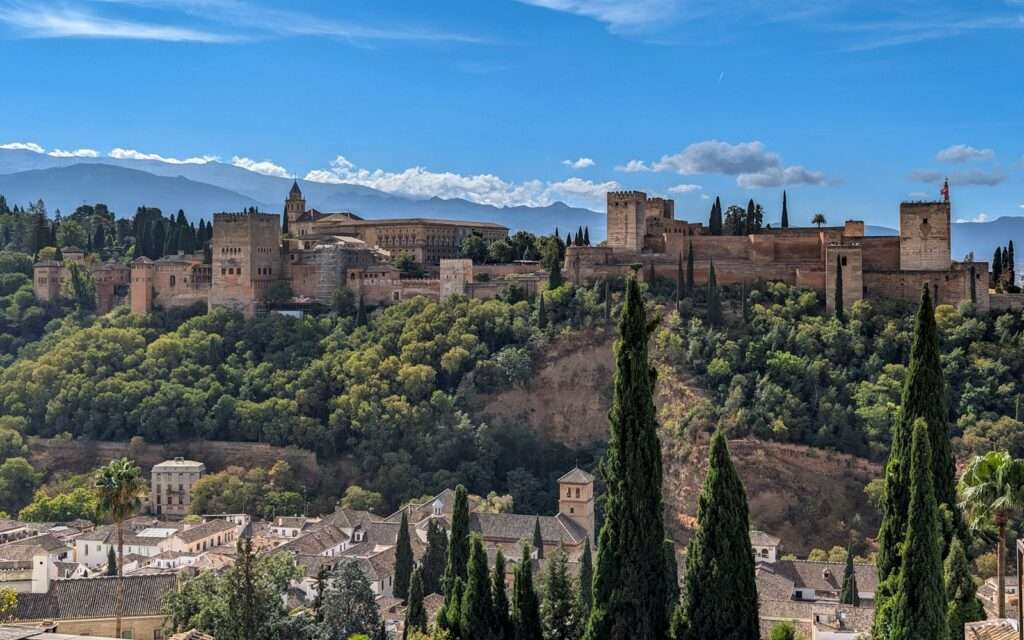
The Alhambra mechanics, in full, because they decide trips: tickets sell only online through the official Patronato site — tickets.alhambra-patronato.es — and lookalike domains sell markups or invalid tickets to careless searchers; there are no on-site ticket counters. The general ticket (about €19 plus a small fee) covers the Alcazaba, Generalife, and a fixed timed slot for the Nasrid Palaces — and that slot is strictly enforced: arrive at the palace checkpoint 15 minutes early, because latecomers are turned away without refund. Every visitor’s ID must match the ticket name; passports get checked. In season, book months ahead the moment dates firm. If the official site shows nothing, the gardens-only ticket and the night visits run separate allocations, and returned cancellations reappear at odd hours. The first morning slot gets the Court of the Lions in low light and thin crowds, and the whole complex asks three to four hours walked.
The rest of the city: the Albaicín’s Moorish lanes climb to the Mirador de San Nicolás, whose Alhambra-against-the-Sierra view at sunset is the city’s ritual (crowded, and worth it; the San Miguel Alto mirador above it trades steps for space). Sacromonte’s cave-flamenco question sorts by intent: the zambra caves run from genuine to staged, and asking who performs and how long the show has lived there is the filter. The Capilla Real holds Isabella and Ferdinand in marble; the cathedral behind it is worth the half hour.
And the tapas rule, stated with pleasure: Granada still serves a free tapa with every drink, by custom strong enough to count as law — order the caña, receive the plate, and dinner assembles itself across three bars. Season math: spring and fall are the windows; summer runs hot with the Alpujarras and Sierra as the escape valves; and winter delivers the postcard nobody expects — the Alhambra red against a snow-white Sierra Nevada.
Frequently Asked Questions
How do you get Alhambra tickets?
Only at tickets.alhambra-patronato.es — online-only, no on-site counters, lookalike sites overcharge. Book months ahead in season, arrive 15 minutes before your strict Nasrid Palaces slot, and bring the ID that matches the ticket name.
What if the Alhambra is sold out?
Check the official site for returned cancellations at odd hours, or take the separate allocations: the gardens-and-Generalife ticket or the atmospheric night visits. Licensed guided tours also hold their own stock.
Are the Alpujarras worth a day?
Yes — the Poqueira gorge’s three white villages, walked between with the bus back, plus jamón at Trevélez and the plato alpujarreño. All curves on the road; spring’s snowmelt-and-blossom window is the best of it.
Can you really ski near Granada?
Forty minutes up — mainland Europe’s southernmost major resort, roughly late November through April, with the Mediterranean visible from the slopes. Spring makes the ski-morning, beach-afternoon double genuinely possible.
Is Córdoba doable as a day trip from Granada?
Yes, as a stretch: about two hours each way for the Mezquita at opening plus the Judería and river. Spring and fall only by preference — Córdoba summers are Spain’s hottest — and Seville needs its own trip instead.